
The FMCG industry hopes for a revival in consumption growth in 2025 with some 'green shoots' already visible, after having a challenging year amid escalating input costs and a double-digit rise in food inflation, which ultimately slowed down the pace of the urban market growth in the second half of 2024. Soaring prices of commodities such as palm oil, coffee, cocoa and wheat forced FMCG players to go for a hike of 3 to 5 per cent or resort to shrinkflation by reducing pack sizes and grammage to retain attractive price points, fearing a volume loss.

'Allocate up to 20 per cent of your core equity portfolio to quality funds.'

In a tightening cycle, a premature pause in monetary policy action would be a costly policy error, Reserve Bank Governor Shaktikanta Das opined while voting along with five other members of the MPC for raising the key lending rate by 35 basis points earlier this month, according to the minutes of the meeting released on Wednesday. Prior to the December hike in repo rate, the RBI had raised the key short-term lending rate by 190 bps in four tranche.

India will be able to manage potential inflationary pressures if forecasts of sub-par monsoon

Among the Sensex firms, State Bank of India, Infosys, Titan, Tech Mahindra, IndusInd Bank, NTPC, ICICI Bank, Power Grid, Reliance Industries and Kotak Mahindra Bank were the major laggards. On the other hand, Tata Motors, Nestle, Hindustan Unilever, Tata Steel, Bajaj Finance and UltraTech Cement were among the gainers.

The rupee tumbled 3 per cent against the US dollar in 2024 as concerns over slower economic growth and a stronger greenback in global markets weighed, but it was among the least volatile currencies in the world and the headwinds may be less intense in the coming year.

India's manufacturing sector activities moderated in December but output remained in the growth territory, amid slower rise in sales and new orders, even as business sentiment was dampened by concerns surrounding supply-chain disruptions, COVID-19 and inflationary pressures, a monthly survey said on Monday. The seasonally adjusted IHS Markit India Manufacturing Purchasing Managers' Index (PMI) eased to 55.5 in December, from November's ten-month high of 57.6. The December data pointed to a "substantial, albeit slower, rises in sales and output", the survey said, adding that the latest quarterly reading was at 56.3, its highest since the final quarter of fiscal year 2020/21.

Grappling with a high rate of price rise, the government on Tuesday expressed concern that increasing prices of crude and other commodities in global markets could add to inflationary pressure in the country.

Apart from the emotional value attached to buying gold, the yellow metal offers protection against inflation, interest rate spikes, currency and geopolitical risks, says Anamika Pareek.
High inflation and slowing down of growth have been forecast by an economic think-tank foe scenario improves, the inflationary pressures are likely to ease in the longer-term, National Council of Applied Economic Research (NCAER) said in its macrotrack monthly report.

Any attempt to push growth beyond 9.5 per cent in the 12th Plan period that begins next year may lead to higher inflationary pressures and current account deficit woes, says Chairman of the Economic Advisory Council to the Prime Minister, C Rangarajan.

The Reserve Bank of India has already raised its key short-term rates by 25 basis points to cool inflation and many experts believe that it will make money dearer to tame inflation in its April 20 annual monetary policy announcement.

On the current liquidity crunch, the HDFC chief said that it was on account of certain cash outgo due to tax and 3G payments but the liquidity position is likely to improve by end-July.

Finance Minister Pranab Mukherjee on Thursday said the Reserve Bank's move to raise its short term lending and borrowing rates is in the right direction as inflationary pressures are still there in the economy.

India's services sector lost momentum in July as demand was curtailed by competitive pressures, elevated inflation and unfavourable weather, a monthly survey said on Wednesday. The seasonally adjusted S&P Global India Services PMI Business Activity Index fell from 59.2 in June to 55.5 in July, pointing to the slowest rate of growth in four months. For the 12th straight month, the services sector witnessed an expansion in output. In Purchasing Managers' Index (PMI) parlance, a print above 50 means expansion while a score below 50 denotes contraction.

Buckling under pressure, the government on Wednesday cut the excise duty on petrol and diesel by Rs 5 and Rs 10 respectively to bring down retail rates from record highs. The announcement comes on the eve of Diwali which will help bring down the skyrocketing prices of fuel and provide some relief to the common man battling inflation.

'If gold's recent surge has increased its allocation beyond 15 per cent in your portfolio, now may be a good time to rebalance.'

India's consumer price index (CPI)-based inflation could ease in the coming months thanks to the arrival of kharif crops, lower international commodity prices, and a pass through of lower input costs to consumers, the finance ministry said in its Monthly Economic Review (MER) for October, which was released on Thursday. The MER, however, warned that the global macroeconomic situation remained precarious and a recession in many advanced economies would impact India's exports. "Easing international commodity prices and new Kharif arrival are set to dampen inflationary pressures in the coming months.
The Reserve Bank of India (RBI) on Thursday said there were signs of moderation in inflationary pressures but warned that commodity prices, despite falling in the second quarter, will remain at elevated levels.

The finance ministry expects a broad-based moderation in inflationary pressures on the back of an anticipated reduction in food prices as a result of the uptick in summer sowing. The retail inflation rate remained stubbornly clung to the 5 per cent mark in seven of the past eight months. "Core inflation is trending downwards, indicating a broad-based moderation in price pressures... Driven by strong domestic growth and benign global commodity prices, core inflation is declining continuously.

India's current account deficit is expected to deteriorate in the current fiscal on account of costlier imports and tepid merchandise exports, according to the Finance Ministry's monthly economic review. The review released on Thursday by the ministry also said that global headwinds would continue to pose a downside risk to growth as crude oil and edibles, which have driven inflation in India, remain major imported components in the consumption basket. For the present, it said, "their global prices have softened, as fears of recession have dampened prices somewhat. This would weaken inflationary pressures in India and rein in inflation."

The two-wheeler segment has shown signs of recovery in the first half (H1) of calendar year (CY) 2024, largely driven by improving performance in rural areas. According to the Federation of Automobile Dealers Associations, rural contribution to two-wheeler sales surged by 57-60 per cent in the April-June quarter of 2024-25, indicating a rising demand in these regions. Experts believe that this trend will continue, supported by a favourable monsoon season and government initiatives aimed at rural development.

The week's losses wiped out investor wealth worth Rs 18.43 trillion, with the total market capitalisation of BSE-listed firms now at Rs 441 trillion.

India's headline retail inflation is expected to moderate further in the months to come, as low wholesale inflation will transmit to consumer prices, the Ministry of Finance said in its latest monthly economic review (MER) on Monday. "Inflationary pressures eased in February, with slight moderation in Consumer Price Index (CPI) inflation and Wholesale Price Index (WPI) inflation softening to a 25-month low. "With WPI inflation easing, its transmission to CPI inflation is soon expected," the MER for February said.

Automakers Maruti Suzuki, Mahindra & Mahindra and Audi India on Monday announced plans to hike prices of their passenger vehicles in January 2024 citing reasons, including cost pressure driven by overall inflation and increased commodity rates. Besides, Tata Motors and Mercedes-Benz India are mulling increasing the prices of their models from January. The country's largest carmaker Maruti Suzuki India, which sells a range of vehicles from entry-level small car Alto to multi-utility vehicle Invicto, priced between Rs 3.54 lakh and Rs 28.42 lakh (ex-showroom Delhi), on Monday said the price hike would vary from model to model.

A reading above 50 means the sector is expanding, while a reading below 50 means contraction.

The Indian rupee is likely to depreciate further against the US dollar through the end of 2024. This is due to the continued strengthening of the greenback, combined with the weakening of the Chinese yuan, which is expected to keep pressure on the Indian currency.

End users should take the plunge despite higher home loan rates as these tend to be cyclical.

A reading above 50 denotes expansion while one below means contraction.

Dabur India has been the worst performer in the fast-moving consumer goods (FMCG) space this year (CY23), posting a 1 per cent decline even as its peer index, the Nifty FMCG, has delivered returns of over 29 per cent in this period.
Most members of the monetary policy committee (MPC) argued for front-loading interest rate hikes in view of rapidly rising inflation during the off-cycle monetary policy review earlier this month - the minutes of the meeting published on Wednesday showed. In early May, the rate setting committee met unscheduled and unanimously decided to hike the repo rate by 40 bps. This was the first repo rate hike in four years, and an inter-meeting hike in more than a decade.

Equity benchmark Sensex tanked 372 points on Thursday, tracking losses in index majors L&T, Infosys and TCS amid a negative trend in global markets. The 30-share index ended 372.32 points or 0.62 per cent lower at 59,636.01. Similarly, the NSE Nifty fell 133.85 points or 0.75 per cent to 17,764.80.

According to the report, going forward, inflationary pressures in some items may increase due to slight improvement in demand.

India's services sector activity moderated further in January as new business rose at a noticeably slower rate amid the escalation of the pandemic, reintroduction of restrictions and inflationary pressures, a monthly survey said on Thursday. The seasonally adjusted India Services Business Activity Index fell to 51.5 in January, down from 55.5 in December, pointing to the slowest rate of expansion in the current six-month sequence of growth. For the sixth straight month, the services sector witnessed an expansion in output.

Benchmark indices Sensex and Nifty settled with gains for the third straight session on Monday, helped by buying in auto, banking and capital goods shares despite a spike in crude oil prices. The 30-share BSE Sensex rose 114.92 points or 0.19 per cent to close at 59,106.44 points with 22 of its components ending in the green and eight closing lower. It moved in a range of 58,793.08 points to 59,204.82 points during intra-day trade.
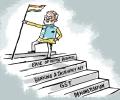
As the Ukraine conflict impacts the global GDP, India is projected to grow by 6.4 per cent in 2022, slower than the last year's 8.8 per cent but still the fastest-growing major economy, with higher inflationary pressures and uneven recovery of the labour market curbing private consumption and investment, according to a UN report. The UN Department of Economic and Social Affairs said in its World Economic Situation and Prospects (WESP) report released on Wednesday that the war in Ukraine has upended the fragile economic recovery from the pandemic, triggering a devastating humanitarian crisis in Europe, increasing food and commodity prices and globally exacerbating inflationary pressures. The global economy is now projected to grow by only 3.1 per cent in 2022, down from the 4.0 per cent growth forecast released in January 2022.

Retail inflation breached the RBI's comfort zone and rose to a three-month high of 6.52 per cent in January, mainly on account of a spike in food prices, as per government data released on Monday. The inflation rate based on the Consumer Price Index (CPI) stood at 5.72 per cent December and 6.01 per cent in January 2022.
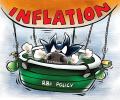
The Reserve Bank of India on Friday raised the retail inflation forecast for 2021-22 to 5.7 per cent due to supply side constraints, high crude oil and raw materials cost. The RBI in June had pegged the retail inflation estimate at 5.1 per cent for the current financial year. The RBI has the mandate to keep inflation in a band of 2-4 per cent, with a tolerance level of 2 per cent on either side.

Manufacturing sector activities in India moderated for the second straight month in July as rates of expansion in output and new orders eased slightly, a monthly survey said on Tuesday. The seasonally adjusted S&P Global India Manufacturing Purchasing Managers' Index (PMI) eased to 57.7 in July from 57.8 in June. Despite the fall, the Indian manufacturing sector maintained strong growth momentum at the start of the third quarter amid ongoing buoyant demand, the survey said.

Petroleum being out of the goods and services tax initially will create some anomaly as tax credit on some of the inputs to oil industry may not be given, said revenue secretary Hasmukh Adhia.
